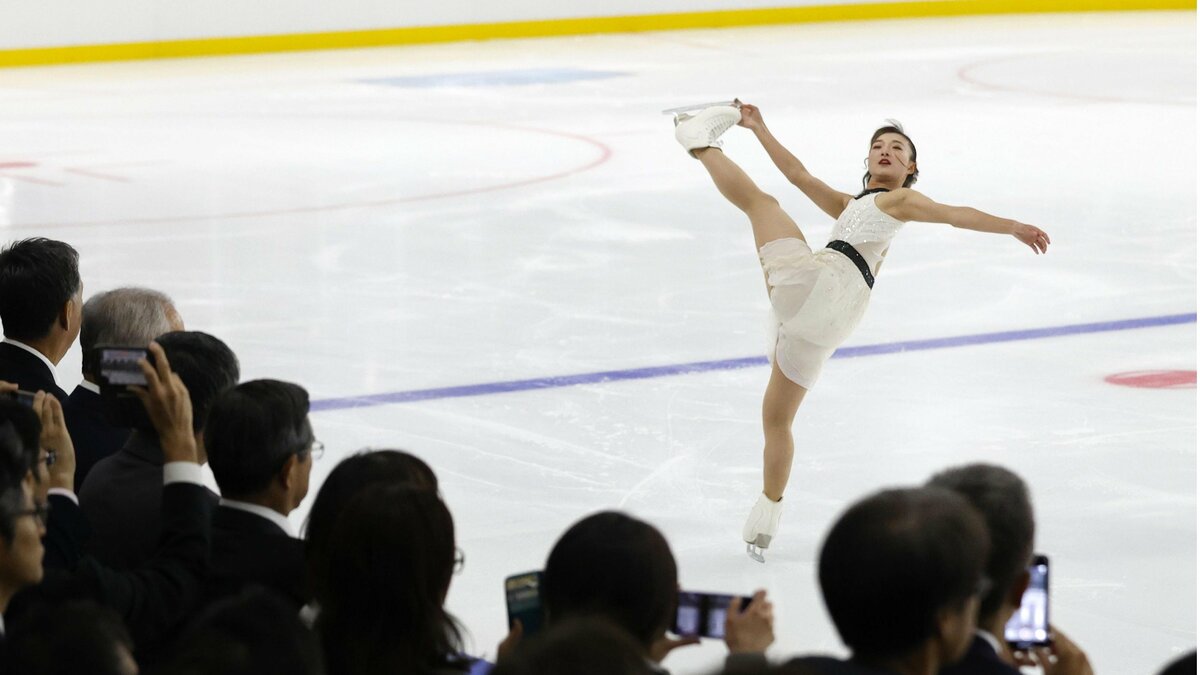
ISU figure skating officials weigh major changes in rules, schedule

Sylvia

Flight #5342: I Will Remember You
Messages
85,170
Article published in Globetrotting by Phil Hersh (Jan. 17, 2026)
Some of the changes in program format being proposed look like a heavy-handed attempt to rebalance the emphasis between artistry and athleticism in a sport where the scoring system now puts a high point value on jumps.
You can call this a case of throwing out the baby with the bath water. Or you can call it the Malinin Rules, designed to reduce the huge advantage 2026 Olympic gold medal favorite Ilia Malinin accrues because of his groundbreaking mastery of all six types of quadruple jump and his singular ability, as seen in this season’s Grand Prix Final, to land seven quads cleanly.
Following are the salient points for singles skating, according to people privy to the discussions and two ISU documents. The second document is an agenda with bullet points for the meeting of Grand Prix host federations that took place Dec. 9 in Nagoya, Japan, where the Grand Prix Final took place.
These rules changes, if approved, also could be implemented for the 2027-28 season.
*Under consideration in singles are a “technical” short program of three minutes with a maximum of four jumping passes and an “artistic” free program of three minutes, 30 seconds with no jumps. They would replace the current short program (2 minutes, 40 seconds, with three required jumping passes) and the free skate (four minutes with seven jumping passes.)
Fabio Bianchetti, the ISU technical committee chair for singles and pairs, broached similar ideas in discussions with me in 2017 and 2020. In an email last week, Bianchetti declined to comment on the new ideas, which have yet to become finished proposals.

Kyodo News article (Jan. 17):
SHEFFIELD, England - The International Skating Union is considering scrapping the current figure skating competition format featuring the short program and free skate to put more focus on the artistic side of the sport, multiple sources told Kyodo News on Friday.
The move comes amid increasing criticism that figure skating success has become too dependent on jumps. The sport's ruling body has held a briefing session for coaches at the ongoing European championships in Sheffield, England, with the introduction aimed for the 2027-2028 season. [...]
Several schedule changes have also been discussed by the ISU, including the creation of a "semifinal" between the Grand Prix Series and the Grand Prix Final from the 2027-2028 season, and the world championships being held in April instead of March.
 
Has figure skating reached the limits of human performance? Associated Press article by Dave Skretta who was in St. Louis (Jan. 16):
By landing the quad axel, Malinin may have maxed out the boundaries of human performance. Most sports scientists agree that the speed and amplitude necessary for five-revolution jumps truly is impossible, leaving figure skating at a crossroads, where a dearth of innovation threatens to take the shine off a sport already fighting to maintain popularity.
“I think it’s kind of natural that we were going to get to this point,” said Malinin, the overwhelming favorite to win gold for the U.S. at the Milan Cortina Olympics. “But I haven’t reached my top, whether it’s in the technical and how much I can jump and spin, but also in the creativity.”
“Absolutely, there are a lot of things I’ve wanted to try,” Malinin told The Associated Press, “because I think it would be really cool and appealing. But it’s a bigger risk for the program itself, and the system and scoring means it doesn’t make sense.”
In other words, what’s the point in trying to innovate?
“There are so many rules in your programs that you don’t have too much wiggle room,” said Alysa Liu, the reigning world champion. “A lot of these rules really restrict us. Like, all of our spins look the same now, but they could look so different.”
“One of my training mates, Sonja Himler Hilmer, does these incredible programs,” added Amber Glenn [...]
“Like, she spins the other way, jumps the other way — really cool things that, you know, someone who’s watched a little bit of skating will be like, ‘Oh, I’ve never seen that before,’” Glenn said. “Whereas if I go and do, you know, the norm, and do it well, versus what she does, my scores will be better, even though what she does is way more impressive, in my opinion.”
 
So many of the proposed changes fail to address the issues the ISU has identified in Hersh's article. I just can't...
And some of the proposals (Two free programs!, 3 GP events for some skaters!) were tried previously...with issues.

I'd be very curious about skater reactions to the notion of off-ice warmup instead of on-ice warmup. They already do off-ice warmup...but getting a sense of how the ice is NOW might be important, given how sometimes the ice in the arena substantially degrades during the course of the competition.

Some of it sounds like it is recreating the old World Pros...which died. Why should this be different?
 
Last edited:
Is there some kind of Athlete Board or representation on the ISU Council comprised solely of former skaters that gets input into these kinds of proposals to give the SKATERS opinion on these things?
ISU Communication No. 2763 Athletes Committee Elections List of candidates and elected positions (Jan. 15, 2026): https://isu-d8g8b4b7ece7aphs.a03.az...list-and-elected-positions-1768465197-977.pdf
Figure Skating Single Adam Hagara (SVK) - confirmed as elected
Figure Skating Ice Dance Evan Bates (USA) - confirmed as re-elected
Figure Skating Pairs Deanna Stellato Dudek (CAN) vs. Wenjing Sui (CHN) - their CVs & statements of motivation are provided at the link above

ETA - under the ISU Office Holders tab: https://isu.org/meet-the-team/?tab=t1

Kaitlyn Weaver (CAN) is the Appointed Skater (2022 - present) and Alper Uçar (TUR) is the Appointed Coach (2022 - present) to the Ice Dance Technical Committee.
Brandon Frazier (USA) is the Appointed Skater (2025 - present) to the Singles & Pairs Technical Committee.
 
Last edited:
Article published in Globetrotting by Phil Hersh (Jan. 17, 2026)


Kyodo News article (Jan. 17):
I'm not sure I'm understanding right. But from the article title, are we saying that the ISU. may get rid of the Short and Free Programs all-together in the future? If so, what will take the place of them and will whatever it is benefit skaters in the future? Btw. are they doing this with all Disciplines of Figure Skating? If you all could explain more to me about what is happening. I can check and follow up with my coach Nick to see what he says on this, and I will get back to you all with an update.
 
I'm not sure I'm understanding right. But from the article title, are we saying that the ISU. may get rid of the Short and Free Programs all-together in the future? If so, what will take the place of them and will whatever it is benefit skaters in the future? Btw. are they doing this with all Disciplines of Figure Skating? If you all could explain more to me about what is happening. I can check and follow up with my coach Nick to see what he says on this, and I will get back to you all with an update.

Why do you increase the font size on all of your posts?
 
I'm not sure I'm understanding right. But from the article title, are we saying that the ISU. may get rid of the Short and Free Programs all-together in the future? If so, what will take the place of them and will whatever it is benefit skaters in the future? Btw. are they doing this with all Disciplines of Figure Skating? If you all could explain more to me about what is happening. I can check and follow up with my coach Nick to see what he says on this, and I will get back to you all with an update.
FSWer, the ISU meets every year. Many proposals are discussed and ideas tossed around. The usual end result is a few little changes here and there. Typically very few drastic changes are made.
 
I don’t want to see Malinin do solo dance! No thanks!
That is exactly what this would be, isn't it? The whole proposal is bonkers. I wonder how much of it is intended as absurd, so that the few things they really wanted get passed as a "reasonable compromise". Some kind of game theory bullshit -- because these can't be genuine ideas.

Skaters will now be happy paying for three programs/costumes because at least the sport wasn't gutted and stabbed in the back right before their eyes.
 
I wonder if anyone has told the ISU what would help increase the sport's popularity the most in the most important market... Much as people might recoil at this but it's been 24 years since a US woman won Olympic gold and 20 years since a US woman won any Olympic medal.

Let's face it, Japan & Korea are decent markets but they're not going to sustain the ISU the same way a US woman winning Olympic gold will.

Also, if they really want to attract more viewers & eyeballs they need to invest in the AI technology necessary to take jump rotation calls out of the tech panel's hands in most instances, plus put some of those fancy graphics the Japanese broadcasters have to show jump height & distance during the replays. Fans crave information & these sort of stats & computer-assisted technical calling will give the sport more legitimacy and attract more viewers in the long run.
 
I think there have to be better ways to increase creativity, improve and reward artistry, and deter menning without going to this extreme. But, it is a challenge and the judging itself - apart from the rules - is part of the problem. Even looking at the way that PCS scores are doled out shows you that. They don't adequately consider the different parts of PCS, and there are PCS bonuses for successfully doing the most difficult jumps. Sonja Hilmer's choreography scores are a perfect example of that.

I do think there are too many jumping passes to leave time and energy for other things. And the rules are too specific to encourage variety and quality in things like spins, footwork, spirals, ina bauers, and even the raspberry twist. (Kudos, though, to Ilia for incorporating the raspberry twist into a spin and to Sonja for spinning and jumping both directions even though there's not much reward for it.) I'm pretty meh on the cartwheels and the back flips, especially when they don't seem to make sense from a musical and choreographic perspective. Again, the "creativity" is too limited and rigid.
 
And some of the proposals (Two free programs!, 3 GP events for some skaters!) were tried previously...with issues.
Skaters are having more problems than ever getting licensing rights for music with multiple skaters being forced to change programs mid season in each of the last few years. So let's make them do an extra program -- that's a great way to guarantee that every skater will be getting one new FP a season and repeating one from the previous season. Will the ISU be increasing the prize money at every event to help skaters cover the cost of the extra costume and choreography? And having to master three programs likely means a lower level of mastery on any given program. Is that what we want?

They say the SP & the FP are too similar, then propose an SP & 2 FPS? What is this madness?

Three GPs for top skaters -- great, there already aren't enough spots at GPs for all the good skaters, especially in pairs. So let's let some skaters take up three of those precious spots instead of two, thus bumping more skaters out of the GPs.

About this Malinin Rule -- I think it's a terrible decision to change the whole structure of competition as we know it based on one skater. He's too talented, too far ahead of the field, so let's change the rules so he can't be rewarded for his high level skills. Who wants to see skaters challenging themselves when we can cut the number of jumping passes in half and increase the penalties for mistakes, ensuring most skaters will be significantly cutting back on their tech level. That setup clears the way for a skater like Jason Brown to win worlds by going clean on the few jumping passes required and getting massive marks in the program that doesn't allow jumps. Nothing against Jason Brown, but is that really better for the sport? And when a skater comes along with generational skating skills (think Patrick Chan) are we going to change the system again if he is winning competitions by too much?

These changes are very reactive. Is there no one forward thinking at the ISU?
 
I’m really not a fan of having a jump-free long program. I want to see mastery of all the big aspects of skating, including the full jump vocabulary along with spins and footwork combined into a performance.

That said, if they wanted to add a different event for artistic skating and judge it solely on PCS, that could be okay. Then skaters could have the choice to go the traditional route, to do both, or to focus solely on the artistic event. And they could test this new event out in senior Bs and possibly on the Grand Prix instead of overhauling our current system into something completely unrecognizable with no data to show that it’s what anyone wants (skaters or fans).
 
I wonder if anyone has told the ISU what would help increase the sport's popularity the most in the most important market... Much as people might recoil at this but it's been 24 years since a US woman won Olympic gold and 20 years since a US woman won any Olympic medal.

Let's face it, Japan & Korea are decent markets but they're not going to sustain the ISU the same way a US woman winning Olympic gold will.
Are we sure about this? It used to be true but with social media these days, you don't have to win Olympic Gold to have a rabid fan base. Also, US companies aren't throwing around $$ like they used to.

Also, if they really want to attract more viewers & eyeballs they need to invest in the AI technology necessary to take jump rotation calls out of the tech panel's hands in most instances, plus put some of those fancy graphics the Japanese broadcasters have to show jump height & distance during the replays. Fans crave information & these sort of stats & computer-assisted technical calling will give the sport more legitimacy and attract more viewers in the long run.
This, I think, is on more solid ground as judging issues are a big problem for many fans and contribute to the idea that figure skating is not a real sport. As for the stats, if you aren't a fan who cares about them, having them shouldn't bother you, while for those of us who do care, it would be awesome. Lots of sports fans like this stuff, so it could attract sports fans who don't currently watch figure skating.

According to the article, a lot of these ideas are coming from the people hired by the new president, who is from the Speed Skating side, and it is implied that the new people aren't from skating. (The Kyoto News article was a mess, probably because it was translated by Google, so I am going to stick with Hersch's article.) I think that explains a lot. A lot.

Under consideration in singles are a “technical” short program of three minutes with a maximum of four jumping passes and an “artistic” free program of three minutes, 30 seconds with no jumps. They would replace the current short program (2 minutes, 40 seconds, with three required jumping passes) and the free skate (four minutes with seven jumping passes.)
No one is asking for this. Literally no one. I have never met someone who said they would watch figure skating if only there weren't so many jumps. Ilia has brought so much attention to the sport, people who weren't watching figure skating before they saw one of his viral routines.

To speed up competitions, the six-minute warmup before each group of skaters will take place off camera. Whether that means on ice or off ice is unclear.
If it's not on ice, it's dangerous. If it is, this would require a 2nd ice surface. I can't see this passing, as no federation is going to vote for it. A non-skater thought of this.

You want to speed up competitions? Turn more of the judging over to automation so it doesn't take as long to mark a program as it does to skate it.

The revised Grand Prix schedule would have two “regular” season events in each of September, October and November, then semifinals in December and the final in January. In Olympic years, the Grand Prix would have just four “regular season” events, with semifinals in November and the final in December.
Good and bad ideas mushed together. Having a GP every two weeks would benefit a lot of people. The semi-final serves no purpose. I saw start out with the GPs from Sept through Nov, the Final in Dec, everyone's nationals in Jan, Euros and 4CCs in Feb. and Worlds in March. If that works, consider expanding from March to April but expanding at both ends all at once is too much.

Other sports have expanded their seasons. But they did it gradually. Not in one year. Also, doing things gradually helps with the issue of contracts and finding room in the schedules of arenas.

One thing I noticed about this proposal is that Nationals seem to be an afterthought in it. This is probably because ISU doesn't control them.

Are they suggesting a no-jump FS to replace the current FS, or as the second FS?
The articles didn't say. It seems like there are two proposals not related. One to have 2 FSs and one to have a FS without jumps. There wasn't anything about having two FS in one competition, so no clue as to how the 2 FSs would work.

Not thought through, IMO.
 
Are we sure about this? It used to be true but with social media these days, you don't have to win Olympic Gold to have a rabid fan base. Also, US companies aren't throwing around $$ like they used to.
Well, we haven't had a Women's FS gold medalist from the USA in this current media & marketing environment. What I will say is that all three of our women are highly marketable and appealing to different segments of the American market but, more importantly, these three are WINNERS and America likes winners - these are tough-as-nails, deliver-under-pressure competitors who have proven over the course of the last two seasons they are, more likely than not, going to rise to the biggest occasion and be exceptionally great. And not even just the three on the Olympic team but the next two behind them. That's the sort of exceptionalism that feeds the American soul.

I could be wrong but I don't think I am and I do think that if one of them wins in Milano-Cortina, that will be the biggest boost to skating's mass appeal here in the US and the US is still the biggest market that everyone wants to tap into.
 
If the problem is that nobody can do as many quads as Ilia, then restrict the numbers of quads per program, alone or in combinations or sequences. Simple.
 
If the problem is that nobody can do as many quads as Ilia, then restrict the numbers of quads per program, alone or in combinations or sequences. Simple.
I mean, that's not really going to change who wins necessarily when someone like Ilia has demonstrated that he has all 6 jumps as quads in his arsenal along with a 4Lz+1Eu+3F along with a 4S+3A that he routinely is putting in the second half of the program. Ilia and his team have studied the rule book and know how to maximize his TES already, they'll do it again within the confines of whatever restrictions are placed on the number of quads he can attempt in any one program.

And, honestly, I can't see most of the larger feds supporting that sort of restriction. They didn't at the 2024 Congress - which is why the implementation of the reduction to 6 jumping passes was delayed until the 2026-27 season instead of being implemented immediately as proposed by the Singles & Pairs TC. That's what is puzzling me about this batch of proposals, to be honest... The USFS, FISG and JSF all pretty much opposed these rule changes a year and a half ago - and they were joined by a lot of smaller feds. So, who exactly in the ISU is continuing to push for these massive changes?
 
I could be wrong but I don't think I am and I do think that if one of them wins in Milano-Cortina, that will be the biggest boost to skating's mass appeal here in the US and the US is still the biggest market that everyone wants to tap into.
I agree it will be a boost to skating's appeal in the US. I think it will be a boost if Ilia wins one as well. I think it will be an extraordinary boost if we win Gold in Women, Men and Dance. Especially if we have two US women on the podium.

What I disagree with is that this will be a big boost in $$ for the ISU that will be bigger than what they get from Asia.
 
If the problem is that nobody can do as many quads as Ilia, then restrict the numbers of quads per program, alone or in combinations or sequences. Simple.
I guess I just don't understand this idea that it is terrible to have a dominant athlete in the sport and we must change the rules to prevent them from winning so much. How many times has it been discussed in the past that one of the reasons people weren't watching figure skating was because there weren't any big enough stars to cross over into popularity beyond the sport? Now Malinin is and the ISU's response is that we must stop this? It's so short-sighted!

When atletes like Usain Bolt and Michael Phelps emerged and were breaking world records left and right and winning all the gold medals, their sports celebrated them and guess what? Their success and the hype around them brought a lot of people to those sports that previously didn't care about them (source: I was one of them).
 
Get AI to mark the technical elements, that would save a lot of time.
It would also be much better at applying the rules, comprehensively spotting under-rotations and less politically biased, unless you use Elon Musk's AI of course.
 
If the problem is that nobody can do as many quads as Ilia, then restrict the numbers of quads per program, alone or in combinations or sequences. Simple.
Before we got to the mega quad era, I thought it might be a good idea to have a limit of 3 quads in the free skate. But even if Malinin's is an outlier, there are multiple skaters who can do 4 or more quads in a program, so it seems really silly to backtrack. I mean, it IS possible for the judges to use the PCS marks correctly even if they currently don't.
 

Users who are viewing this thread

Back
Top
Do Not Sell My Personal Information