Scientific observation

Oh well, it was fun while it lasted.
It sure was. It could have been a Star Trek movie where the Cardassians blew up 3l/ATLAS as they approached the sun because they considered them a threat. Sorry. I let the Trekkie in me get carried away. ;) :lol:
 
In 2000, there was a psychic that predicted that he knew when the earth would end and how it would happen by the end of this year. He claimed a comet would end humanity.

Well, he did predict correctly that there would be a comet to show up in 2025 which Is 3I/ATLAS. At first, the scientists did believe that 3I/ATLAS blew up into 3 pieces when it approached the sun.

However, in November 2025 the scientists confirmed it's still largely intact, exhibiting strong outgassing (jets of gas/dust) and multiple tails, and not a completely shattered body even though its structure has been dramatically altered by the Sun's heat.

I'm a psychic, and I know when and how humanity will be wiped out


A spiritual leader from Pakistan has emerged with an apocalyptic prediction for the coming years.

Riaz Ahmed Shahi maintains that a comet will strike Earth and eliminate all living creatures on the planet before the end of this year.

The catastrophe would serve as divine retribution on humanity for drifting "too far from spiritual truths", according to the Daily Mail.

"A comet has been sent towards Earth for total destruction. The comet is expected to fall on Earth in the next 20-25 years. That will be the last day of this world", Shahi wrote in his 2000 book The Religion of God.

The mystic is a religious figure who has established multiple organizations, including Anjuman Serfaroshan-e-Islam and Messiah Foundation International (MFI), all promoting his philosophy of "divine love", reports the Express.

His teachings combine the Islamic tradition of Sufism with eschatology and include harsh criticisms of how authorities and institutions appear more interested in space exploration than human welfare.
 
This is a video that was on my homepage.

Why NASA wants to build a space station around the moon


Gateway is NASA's most ambitious project yet, so how do they plan to get a space station around the Moon? And why have one there in the first place? SLS, Artemis and Gateway.
 
@Tesla , I guess it's Si-Fi movie time again. :lol:

3l/ATLAS still showing strange protrusion as it approaches Earth


The interstellar object 3I/ATLAS is expected to make its closest approach to Earth mere days from now, coming within just 167 million miles — a significant gulf, but a mere stone’s throw on the cosmic scale.

It’s an exciting moment that’ll give astronomers an unprecedented chance to point both ground- and space-based telescopes at the unusual visitor. They’ve been following the object, which is broadly believed to be a comet, for months now as it screams through the solar system.

Ever since NASA’s Hubble Space Telescope first gazed upon the object on July 21, scientists noticed a strange protrusion jutting out of the object, a second tail that counterintuitively points directly at the Sun, not away from it like the characteristic tails of familiar solar system comets.

This “anti-tail” could be the result of “enhanced mass loss in the Sun-facing side,” as Harvard astronomer Avi Loeb told Futurism earlier this year, which causes larger fragments to be broken off. These larger fragments are less susceptible to being affected by the Sun’s radiation pressure, causing them to move more slowly and accumulate on the Sun-facing side.

Over a month after its perihelion, or closest pass of the Sun, observations still clearly show 3I/ATLAS’ anti-tail, as Loeb noted in a new update on his blog. A December 13 image taken by the Teerasak Thaluang telescope in Rayong, Thailand “shows a prominent anti-tail, uncommon for comets, pointing in the direction of the Sun,” he wrote.

Judging by the “thousands of images” taken since Hubble’s July observations, which show 3I/ATLAS’ anti-tail, Loeb argued that it’s “not a perspective effect,” but a “real physical jet.”
 
It's happening today, @Tesla!


The world’s 3rd known interstellar object – 3I/ATLAS – made its closest pass of the sun back on October 29, 2025. It’s now heading out of the solar system. But not before it makes its closest pass by Earth, which happens today (December 19, 2025). At its closest point, 3I/ATLAS will pass within 1.8 AU (168 million miles or 270 million km) of Earth. So it’s not really close. It’s farther than the sun, Mercury, Venus and Mars all get from Earth. But it’s the closest this object will come.

The latest news on Comet 3I/ATLAS involves its source of acceleration. The comet is ripping through our solar system at around 130,000 miles per hour (210,000 kph). That’s the highest velocity ever recorded for a solar system visitor. In a paper published in the Research Notes of the AAS on December 9, 2025, scientists discuss the comet’s non-gravitational acceleration. Its gravitational acceleration is from passing the sun. But the non-gravitational acceleration is not – as some hoped – from an alien engine. It’s from outgassing. Because, of course, this interstellar object is a comet, and comets sublimate icy material when they get near stars. The scientists used data from multiple spacecraft to measure the small accelerations.

NASA held a press conference on November 19, 2025, to share the images that various space missions have collected of Comet 3I/ATLAS. Associate Administrator Amit Kshatriya started the conference by reassuring the public that this interstellar object is indeed a comet, and nothing related to extraterrestrial life, which has been widely speculated on social media.

You can rewatch the conference on YouTube:

NASA Shows Interstellar Comet 3l/ATLAS Images


Nov 19 2025 - Tune in as NASA shares the latest images of the interstellar comet 3I/ATLAS, collected by several NASA missions.First observed earlier this year, the 3I/ATLAS comet is only the third object ever identified as entering our solar system from elsewhere in the galaxy. While it poses no threat to Earth and will get no closer than 170 million miles to Earth, the comet flew within 19 million miles of Mars in early October.
 
From NASA news on YouTube:

NEW OBSERVATION 3l/ATLAS Emits X-Rays as it Passes Through Our Solar System


ESA’s XMM-Newton space telescope has detected interstellar comet 3I/ATLAS emitting X-rays as it passed through the Solar System. This rare observation gives scientists a new way to study material formed around other stars and understand how interstellar objects interact with the solar wind.

From IFL Science:


The emission of X-rays is usually the domain of the energetic events of the universe: hot stars, supermassive black holes, and the like. However, since 1996, with Comet Hyakutake, we have learned that even comets can emit X-rays. But despite efforts, no such signal was ever seen for an interstellar object. Enter this year’s superstar Comet 3I/ATLAS, breaking yet another record.

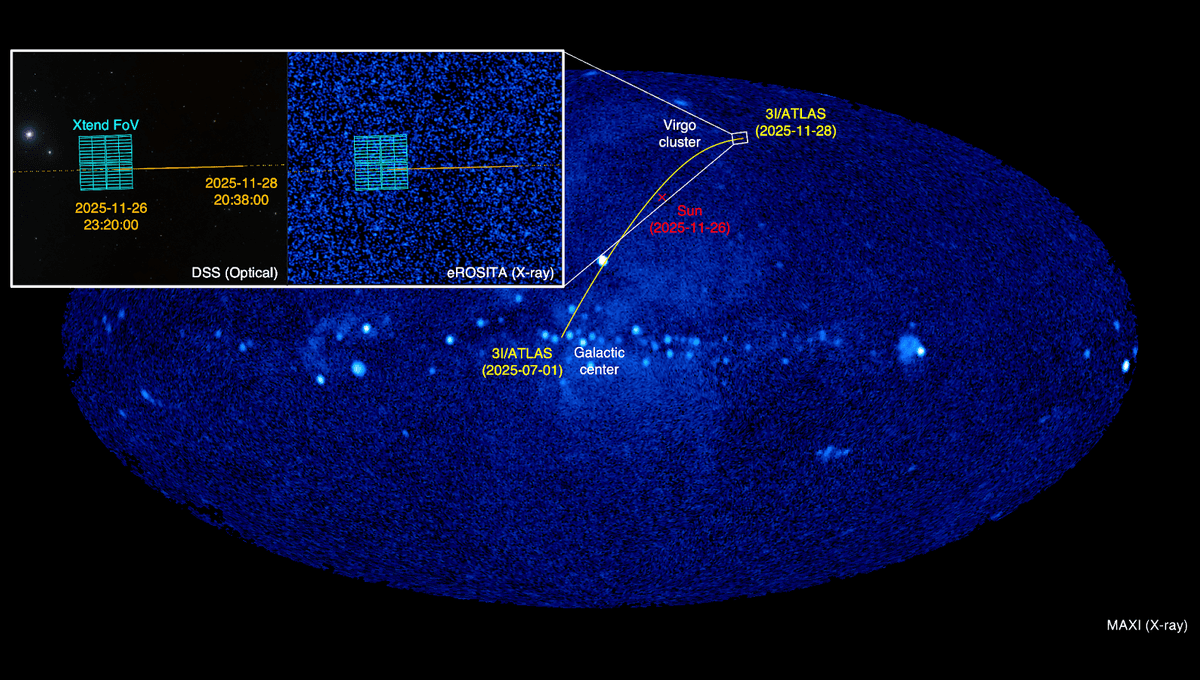
Interstellar object 3I/ATLAS is different from its predecessors, 1I/’Oumuamua, discovered in 2017, and Comet 2I/Borisov in 2019. It’s faster, it’s older, more active, and estimated to be larger. Now, observations from the X-ray telescope XRISM suggest that it is also the first interstellar object with an X-ray signature.

Before the conspiracy theorists claim that this is some sort of engine signature or a weapon charging up, let’s stress that it is perfectly normal for comets to emit X-rays. This emission comes from specific interactions between the plasma released at high speed by the Sun and the coma, the atmosphere of the comet. This is gas and dust released as the comet gets near the Sun.

The plasma slams into the gas of the coma, and it can rip electrons from the gas’s atoms. The electrons are pushed away with such energy that they begin to emit X-rays. It doesn’t matter that comets are among the coldest objects in the universe. This plasma interaction produces electrons with a temperature of millions of degrees.

The data was collected from 23:20 on November 26 to 20:38 on November 28, 2025, with an effective exposure of 17 hours. The primary analysis is consistent with a faint X-ray glow spanning 400,000 kilometers (250,000 miles). The team believes that it would be difficult to explain this signal just with noise from the detector.

While more work is necessary, the team has other preliminary evidence. The X-ray signatures of carbon, nitrogen, and oxygen appeared in the data in a way that couldn't happen if there was a different source, such as the galaxy at large or even from our own atmosphere.[/b]

 
  • Like
Reactions: KCC

Users who are viewing this thread

Back
Top
Do Not Sell My Personal Information