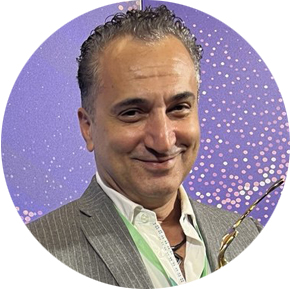
Ari Zakarian interview

Upon further review, I now recall that a mutual friend who worked on Wall Street introduced me to Ari at 1996 Skate America in Springfield MA as they both skated at Chelsea Piers in NYC. We reconnected at 1997 Europeans in Paris when I was credentialed with Grishuk/Platov and I remember hanging out with him at the Gala at the Old Paris Opera House, the primary setting of Andrew Lioyd Webber's Phantom of the Opera. I am embarrassed to admit that POTO is my all-time favorite Broadway musical, having seen it live in NYC circa the late 1990s and 2019, and I didn't realize the staircases and chandeliers at the Gala were later sets in Phantom!

It was at 1997 Worlds in Lausanne where Ari showed up with his bandaged wrist following the car accident, so I definitely had met him prior to the incident with Baiul. He's a very charismatic guy and seemed to know everyone connected with figure skating and took time to get to know me due to my connection with Oksana and Evgeny in U Delaware.

I haven't seen Ari since the initial public performance of Evgeny with Maya at Harvard University for the Jimmy Fund in fall 1998, where he performed with Akop in the fundraiser. Definitely an interesting dude and yes, he's the force behind the ISU Awards.
Please enlighten me.

I have to say I always love your stories.
 
Please enlighten me.

I have to say I always love your stories.
Post #9:
The first or second time I met Ari Zakarian around 25 years ago, he still had his wrist bandaged from being the passenger when Oksana Baiul wrapped her car around a tree in her infamous drunk driving episode!

January 1997:
 
The funniest part about all this is the Ilia is so Westernized and seems to not care one bit about Russia. Does he even speak Russian fluently?
It's his first language, of course he speaks Russian well. You might be interested to know that he gave an interview in Russian to the Russians after the GPF. He, Maxim and Andrew also gave an interview fully in Russian back in 2020. Ilia speaks with his parents at home and grandparents in Russia (since his grandpa can't visit them in the US anymore, they communicate via skype), he is also friends with Artem Kovalev who just recently said he and Ilia spoke in Russian with each other when they were hanging out in Linz as juniors. Ilia has literally family in Russia, you saying he doesn't care about Russia and mocking his roots is just weird to me. Oh, and his favorite skaters are Trusova and Kolyada :)
 
It's his first language, of course he speaks Russian well. You might be interested to know that he gave an interview in Russian to the Russians after the GPF. He, Maxim and Andrew also gave an interview fully in Russian back in 2020. Ilia speaks with his parents at home and grandparents in Russia (since his grandpa can't visit them in the US anymore, they communicate via skype), he is also friends with Artem Kovalev who just recently said he and Ilia spoke in Russian with each other when they were hanging out in Linz as juniors. Ilia has literally family in Russia, you saying he doesn't care about Russia and mocking his roots is just weird to me. Oh, and his favorite skaters are Trusova and Kolyada :)
Ilia has stated many times that he most looks up to Yuzuru and Jason as skaters. He has also stated that he appreciates/admires Trusova, but I've never heard him mention Kolyada.

He has also made it clear that while he can speak Russian, he doesn't know how to read or write in Cyrillic, which calls into question his overall fluency/literacy in the language.

I wouldn't say he has mocked his Russian heritage or is ashamed of it, but I think it was also pretty clear from WTT that he is very happy and proud to be an American and represent the country of his birth.
 
Ilia has stated many times that he most looks up to Yuzuru and Jason as skaters. He has also stated that he appreciates/admires Trusova, but I've never heard him mention Kolyada.

He has also made it clear that while he can speak Russian, he doesn't know how to read or write in Cyrillic, which calls into question his overall fluency/literacy in the language.

I wouldn't say he has mocked his Russian heritage or is ashamed of it, but I think it was also pretty clear from WTT that he is very happy and proud to be an American and represent the country of his birth.
I didn't say HE is mocking his Russian heritage, but the posters here who are denying his connections to Russia ?
His fluency sounds good, it was the Russians who said his Russian is "excellent", they will know better than us. The fact that he is bilingual ( he also talked about this) also means he has typical bilingual problems when switching languages, nothing out of norm. He said back in 2020 that he feels 30% Russian and 70% American. And he did talk about Misha being his idol, many times. You never watched his Insta lives?

His Russian interviews ( if the links work, idk how this works lol)

In 2020
https://youtu.be/llihrI55KW8

After the GPF
https://youtu.be/n99WoXxkdqY
 
:lol: People aren't denying his Russian heritage. They are mocking the Russians for claiming him as one of their own. Those aren't the same thing.
...and, on the same time, no one of them claims poor Stephen Gogolev like their own.... even thought Gogolev is the one who learned his first steps in skating in Russia....ha! ha! it is as miserable as it is, Russians do not need him
It is undeniable that one needs to have a great success and then he/she will be claimed Russians... these claims are made in the arrogance at its highest! and, yes, why didn't Russians embrace that beautiful girl who skated for Russia, Ksenia Makarova?? Ha! wasn't it because she was not successful enough? of course it was so. Its miserable.
 
Last edited:
Translation of a new Ari Zakarian interview by sport24.ru's Konstantin Lesik (June 14): https://fs-gossips.com/ari-zakaryan...-it-would-have-raised-the-level-of-our-sport/
Excerpts:
How much should a quadruple axel be worth then?
AZ: I asked Brian Boitano, Scott Hamilton, Evgeni Plushenko, and Viktor Petrenko this question. They are all Olympic champions, people who know their craft. They all unanimously believe that its value should be increased. They mentioned a range from 15 to 22 points.
In reality, if the world had been properly informed that there is a guy named Ilia Malinin who performed quadruple axel at the World Championships for the first time, and if this element had been scored appropriately, it would have raised the level of our sport on a global scale.
Currently, figure skating is watched by fans, but we need figure skating to be watched by spectators. It would add popularity, money, sponsors, and everything would be good in the future. Unfortunately, marketing is severely lacking in our sport today.
If Ilia’s jump received the recognition it deserves, sponsors would come to American figure skating as well. Figure skating in Russia has gained significant traction over the past 5-6 years. Other countries don’t have that. In Japan, it’s popular largely because of Yuzuru Hanyu. And if the world knew about Ilia, it would only benefit the entire figure skating community. But our officials don’t understand how crucial of a marketing move it is for themselves, for everyone. It would bring tremendous income to the entire community.
In your opinion, does the figure skating community feel a lack of Russians, or are they happy to compete without them?
AZ: When phrases like “they would come and tear you apart” or “no one in Russia watches the World Championships because no one cares” are heard in international figure skating, such moments definitely do not contribute to public opinion.

Should we strive to establish contact regardless of circumstances?
AZ: There is no need to belittle or scorn anyone. I know examples where great figure skaters are asked if they will watch the World Championships, and they respond, “What is there to watch?” Such statements do not bring any honor. For example, I enjoy watching championships from various countries, even those not known for their strong figure skaters. It’s understood that the level is different there, but I’m still interested in observing how things develop.
It’s important to understand that the longer people in Russia say, “Everything is bad without us,” the more others will strive to prove, “We can manage without you.” The World Championships in Japan went quite well overall. There was a good level, and the men’s competition was simply stellar. It was the strongest championships in men’s skating. If our guys had competed, it would have been very tough for them. There was strong competition in ice dance as well. In womens’ singles and pairs, it’s clear that Russians would have contended for top positions.
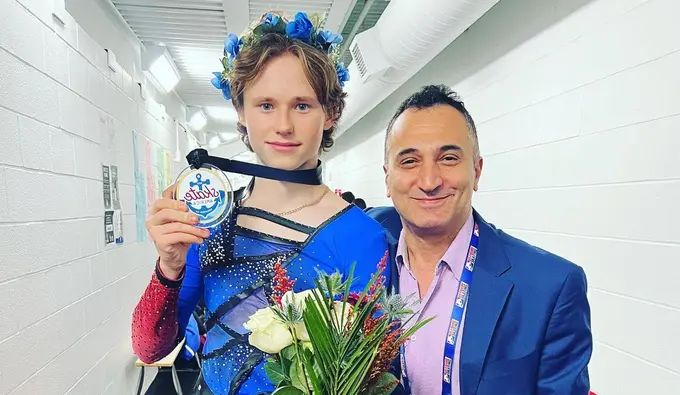
 
Blog interview with Ari Zakarian by Alisa Barladyan [link to her profile] (April 19, 2024):
 
Ari Zakarian was interviewed by Rustam Imamov after the ISU Grand Prix Final in Grenoble (December 9, 2024): https://www.championat.com/figuresk...an-pri-i-ocenkah-amerikanca-ili-malinina.html
Google translated excerpt from the introduction:
... The main event was Ilia Malinin's performance in the free program. The American skater attempted seven quadruples at once for the first time in history, but did not receive a proper reward for his enthusiasm.
Having failed only one jump in the final protocols, Malinin underrotated on each of the quads [4Fq, 4Aq, 4Lz< fall, 4Lo<, 4Lz<+1Eu+3S, 4Tq+3T, 4Sq+3A+SEQ]. As a result, Ilia even lost the free program to the Japanese Yuma Kagiyama, who was also not perfect. This situation seriously puzzled the agent of the American athlete Ari Zakarian. One of the most influential "producers" in figure skating in a conversation with "Championship" came to a disappointing conclusion: the current policy of the ISU , aimed at trying to artificially stop the progress of the sport, will lead to a loss of spectator interest, and along with it - to the decline of the industry.
A translation: https://fs-gossips.com/13168/
 
(Never heard of metaratings.ru ... the original article in Russian was published on March 29, 2023): ...
Bumping this thread back up...

"Ari Zakarian, vice president of the Armenian Figure Skating Federation, ice show producer, choreographer, and agent for Ilia Malinin, one of the top 2026 Olympic favorites, spoke with Metaratings.ru about the results of the [Russian] national championship and the chances of Russian Olympians in Italy."

Translation of the Malinin part at the end of the interview:

ETA 2 auto-translated excerpts:

Gumennik has more points than Kagiyama. Did Petr skate better, or do judges in Russia inflate scores?

"The National Championships aren't a scale for measuring scores. Anything can happen at the Olympics. I'm very happy for my friend Rafael Arutyunyan; he's proven once again that he's one of the best specialists in the world. Gumennik himself said so. He came there specifically to work on his quadruple Lutz, toe loop, and loop. Judging by his work, these elements were executed well."

– How would you rate Gumennik’s form before the Olympics?

"It's clear he's improving with every competition. His peak should come at the Olympics. I think we're in for an interesting tournament. Gumennik's form clearly shows how much he worked with Arutyunyan. Rafa is a serious figure skating professional."

[...]

Adelia Petrosyan didn't skate entirely clean at the Russian Championships and has had an inconsistent season overall. Could this be a concern for fans?

"She's under tremendous pressure from all sides, plus a huge responsibility. Adelia has an inner strength that should be a plus. She'll be more resilient at the Olympics. The competition was tough at the Russian Championships, but compared to the world level, I wouldn't jump to conclusions. Don't underestimate the Japanese, American, and other athletes."

Many experts in Russia are confident that Petrosyan is heading to Italy for gold and will be the top favorite. Does she have the edge?

– Anything can happen at the Olympics.

– Will Petrosyan be in the same form as last season in February?

"I watched her training, and she looked good. A month and a half is a good amount of time to work calmly and correct any mistakes."
 
Last edited:
Many in the world of figure skating know the name Ari (Ararat) Zakarian. Originally from Yerevan, Zakarian is a leading sports manager and producer of ice shows, the initiator of the ISU Skating Awards, and the agent of two-time world champion Ilia Malinin (USA). He combines his international activities with his position as vice president of the Figure Skating Federation of Armenia.

Zakarian spoke about the state of Armenian figure skating, its challenges, and its enormous potential. We also discussed the prospects of Armenian figure skaters at the upcoming Winter Olympics in Milan in February 2026, as well as Ari Zakarian's career.


Auto-translated excerpts:

- When the international situation changed in 2022, I made it clear that Armenia had the opportunity to create its own figure skating team capable of competing for Olympic medals by 2026. I came up with a program and guaranteed that I could make it happen. I didn't receive the necessary support. The time was lost. Why didn't Adelia Petrosyan, who is now the leader of the Russian team, compete for Armenia? What would she have had to compete with? There simply isn't enough support to pay for training at the required level. I brought Adelia to Yerevan back in 2017 and told her that she was a future Armenian superstar. Back then, no one knew about her or talked about her. I said this with an eye to the future, but that was it.

In the end, what happened? Georgia, which until recently didn't have a single skating rink, is now one of the leading teams because they have support and funding from the state. And I wouldn't be surprised if they win a bronze medal in the team competition at the Milan Olympics. A wonderful arena has just opened in Tbilisi; I was there recently for the Trialeti Trophy. There's a skating rink in Batumi, and 10 more arenas across the country are planned for the near future. Our other neighbors, Azerbaijan, also had nothing, but now have tremendous conditions they can count on to achieve their athletic goals. The development of sports, in its various disciplines, is especially important in the age of technology. We're concerned that children are spending too much time in front of screens, and there are threats from artificial intelligence. In this situation, sport is the one thing that simply can't be replaced. It's the health of the nation, the key to a healthy future for humanity. And yet, in Armenia, almost no attention is paid to this.

[...]

At the upcoming Winter Olympics in Milan, Armenia will be represented by Karina Akopova and Nikita Rakhmanin, a pair who train in Sochi with Dmitry Savin and Fedor Klimov. Tell us about this promising pair.

I've known the guys for many years. Karina has long wanted to compete for Armenia. I want to thank, first and foremost, the Russian Figure Skating Federation for providing this opportunity and not creating any problems with the guys' transition to the Armenian flag. Karina and Nikita followed all the rules, sat through the quarantine from start to finish, and received Armenian passports. Of course, this wasn't easy for them. They hadn't competed for two years and had no guarantees whether Russia would let them go. They had their last chance to qualify for the Olympic Games in September at the tournament in Beijing, and they took it. I'm incredibly happy for them and grateful to their coaches.

The fact that they will now be competing at the European Championships in January and then at the Olympic Games is a huge step. For the first time in our sport, Armenia has athletes who have the opportunity not just to participate, but to compete for serious spots. Before, our goal was always simply to participate in the Olympic Games.

- And to qualify for the free skate.

- Yes, that was the main goal. And now Karina Akopova and Nikita Rakhmanin have a 100% chance to shine in the next Olympic cycle. God willing, their health will be fine.

[...]

Ari, let's talk a little about you. How did you get into figure skating, since it's far from the most obvious sport for someone from Armenia?

When I was four years old, the "Arachin Mas" figure skating school in Armenia announced enrollment. My parents brought me there. For the first two years, we had no ice at all: we trained on a parquet floor with skates. Then we got a small, terribly uneven 30x30 meter ice surface. But we formed such a fanatical group, which produced Armenian skaters and coaches who are still in demand and recognized in the world of figure skating. The Armenian school was becoming recognizable. We successfully competed in the USSR championships: we won the National Championship Cup and participated in international tournaments.

Then I moved to Leningrad to Alexei Nikolaevich Mishin, with whom I worked for eight years and achieved my greatest results. I won the Leningrad championship four times, won silver at the USSR Junior Championships, and was the first in the world to perform the cantilever in competition. I ended my athletic career early due to a severe spiral fracture of my leg. Returning to the ice a year later, I realized the road back to professional sport would be too difficult.

So, together with my friend Akop Manoukian, we became the founders of acrobatic figure skating. We became soloists with the Leningrad Ice Ballet and toured all over the world. Incidentally, we became soloists thanks to our signature Armenian dance, the Kinto. During difficult times, we moved to the United States and reached a new level, performing in leading ice shows. We began at the Ice Theatre of New York. In the Disney on Ice show, we were the only artists announced by name and with their country indicated. We skated the same "Kinto." This is a rare and perhaps unique event in Disney history, one that I remember with great honor. Later there were other shows, including Tom Collins' famous Champions on Ice, where we shared the rink with Olympic stars, even though we weren't even Olympians ourselves.

How did you transition "to the other side"—from a show performer to a producer and agent?

I was naturally quick to connect with people, and over time, figure skaters and artists from the former Soviet Union began contacting me asking for help finding a job. My first clients were the pair Elena Leonova and Andrei Khvalko, and later, acrobats Vladimir Besedin and Alexei Polishchuk. I was invited to work for International Figure Skating magazine as an International Liaison. There, I did insider reporting and found myself at the European Championships, where Evgeni Plushenko made his debut. Over time, I became his agent and manager.
After September 11, I began my career as an individual sports agent.

You've said more than once that potential commercial gain is secondary to you if a project could harm your athletes' athletic achievements. Why is this important to you?

Reputation is paramount in this business. I've been working for many years, and of the companies I started with, only IMG and myself remain afloat in the US. Of course, new players have emerged, but of the old ones, no one else is left. I always prioritize the athlete's interests, not quick profits. It's a systematic, smooth process. This path is long, but steady. Today, I'm at the very pinnacle of this path thanks to my athlete, two-time world champion Ilya Malinin. I'm incredibly happy to see his high-quality work in training and competitions.
 

Users who are viewing this thread

Back
Top
Do Not Sell My Personal Information